

OUR GOVERNANCE

Corporate governance aligned to the King IVTM principles
The delivery of our purpose and strategy is underpinned by our governance approach.
OUR VALUE-CREATING GOVERNANCE APPROACH
The principal purpose and object of the Institute as described in its constitution is to promote the common interests of members and associates and the public interest by enhancing the relevance, values, competence and influence of members and associates in South Africa and abroad. SAICA also subscribes to King IV’s voluntary principles and leading practices in support of this unique mandate.
Good corporate governance is achieved through the Board’s commitment to ethical and effective leadership, strategic direction setting, and appropriate oversight towards achieving the four governance outcomes of ethical culture, good performance, effective control, and legitimacy.

Good Performance
Effective control
Legitimacy
Ethical culture
There are ongoing efforts to further embed the King IVTM principles into the Institute’s day-to-day business activities. The Board is satisfied that the Institute is aligned with the key principles and is mindfully overseeing the application of the relevant practices.
Heightened focus areas of the Board in 2023
REVIEW OF SAICA GOVERNANCE STRUCTURE
ONBOARDING OF NEW CHIEF EXECUTIVE OFFICER
2024 PLAN FOR AN EVALUATION OF THE BOARD AND ITS COMMITTEES, CHAIRS AND INDIVIDUAL MEMBERS
OVERSIGHT OF THE PROCESS TO FORMULATE THE STRATEGY 2024−2028 – UNDERPINNED BY A STAKEHOLDER-INCLUSIVE APPROACH
OUR GOVERNANCE FRAMEWORK
The governance framework prescribed by the SAICA constitution enables the Board to oversee, assess and approve the strategic direction, financial and non-financial performance areas, resource allocation and risk appetite of the Institute. It also supports the Board in ensuring that it can hold the executive team accountable for the execution of the Institute’s strategy key performance areas.
GOVERNANCE FRAMEWORK

The SAICA Governance Framework is built to comply with the directives from various documents which are depicted below. Documents with prescriptions regarding these committees exist.
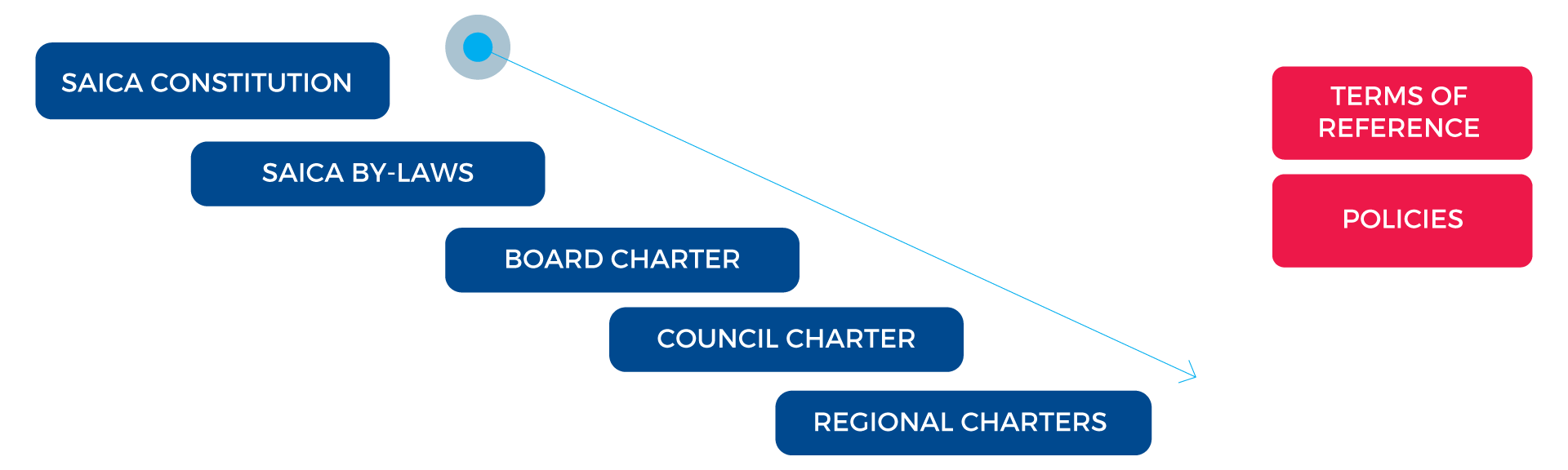

BOARD CHARTER
The SAICA Board Charter regulates the parameters within which the Board operates and ensures the application of the principles of good corporate governance in all its dealings. Additionally, the Charter sets out the roles and responsibilities of the Board and individual members, including the composition and relevant procedures of the Board, and is aligned with the provisions of the SAICA constitution.
The Charter further addresses the powers delegated to various Board committees and practices of the Board in respect of matters such as corporate governance, declarations and conflicts of interest, Board meeting documentation and procedures, including the training and evaluation of directors and members of Board committees. The Charter is reviewed annually, or as and when required during the year. In addition to the regulatory framework provided by the Charter and the terms of reference of the committees.
BOARD MEETINGS
The Board uses its meetings to discharge its governance and regulatory responsibilities. Meeting agendas follow an approved annual work plan and also provide for the inclusion of urgent non-routine matters. Meeting agendas comprise management reports on operational and financial performance as well as matters of strategy execution and risk and opportunities; governance, compliance and legal issues; and matters otherwise reserved for Board decision-making.
The Board met 12 times (includes seven special meetings) during the year at which there was 96% attendance by members (refer to www.saica.org.za for Board meeting attendance).
ACCESS TO AND FLOW OF INFORMATION
Members of the Board have unrestricted access to the Executive Committee, senior management and company information, as well as other resources required to carry out their duties and responsibilities, through the Board Secretary.
EXTERNAL ADVISORS
Access to specialist advice is available to directors at SAICA’s expense and experts are used to advise the various Board committees.