
OUR CONTEXT
OUR BUSINESS
The below information helps identify potential risks, update existing risk profiles where relevant, and determine additional mitigating actions if needed. While these risks do not currently have a negative impact on SAICA, they are actively managed to ensure organisational resilience.
Potential Risks
Description
South Africa’s mathematics crisis
The decline in learners taking and passing mathemathics poses a long-term risk to the pipeline of future CAs, which could impact SAICA’s membership and sustainability
Related Strategic Risks
Risk Response
Maintain and enhance relations with the Provincial Departments of Basic Education to ensure a collaborative approach in the promotion of mathematics and the accountancy profession
Description
Declining pass rates in Historically Disadvantaged Individuals passing APC
A significant drop in the pass rates for Black candidates in the Assessment of Professional Competence (APC) exam poses a risk to the diversity and inclusivity of the profession
Related Strategic Risks
Risk Response
SAICA is addressing this through awareness campaigns and by reviewing systemic challenges related to this decline
Description
Accounting, auditing, professional and other standards
Sustainability reporting standards: New standards may require specialised skills, necessitating investment in member development for effective adherence
Retirement fund accounting: A shortage of qualified retirement fund accountants may arise, requiring professional development programmes
Public sector consultancy fees: Scrutiny by the Auditor-General over ‘consultant fees’ could implicate members providing services to the public sector
Member mobility from public to private sector: Perceived barriers may hinder members’ transition from the public to the private sector
Related Strategic Risks
Risk Response
Description
Generative AI and IT security
The rapid advancement of AI technology presents both opportunities and risks for the accountancy profession, including the potential for AI to disrupt traditional skills and job functions
Related Strategic Risks
Risk Response
An AI Policy and framework has been developed to mitigate associated risks, such as cyber threats and technology obsolescence, while leveraging AI to enhance professional capabilities
Description
Inability to support legacy systems due to outdated software
Related Strategic Risks
Risk Response
Description
Public scrutiny of SAICA member disciplinary process
The rise in high-profile disciplinary cases involving SAICA members has created reputational risks, increasing pressure on the accuracy and efficiency of disciplinary outcomes
Related Strategic Risks
Risk Response
Description
Internal control environment
Deficiencies in some controls, processes, and culture increase the risk of errors, fraud, and inefficiencies
Related Strategic Risks
Risk Response
Description
SAICA PMO and change management governance
Inadequate governance and assurance within the project life cycle, affects timelines and future efficiencies
Related Strategic Risks
Risk Response
Continuous enhancement of project management practices to embed governance at the operational level
Sustainability and ESG Risks
As the global focus on Environmental, Social and Governance (ESG) factors intensifies, SAICA recognises the growing importance of incorporating these elements into our risk management processes. We understand that ESG risks are not only critical to long-term business sustainability but also to our responsibility as a leader in the profession.
In 2024, SAICA strengthened its commitment to addressing ESG-related risks by integrating them into our Enterprise Risk Management (ERM) framework. Our approach to managing ESG risks is multifaceted, covering environmental impact, social responsibility, and governance practices. These factors are assessed and managed through ongoing collaboration across various departments, ensuring that we respond effectively to emerging challenges.
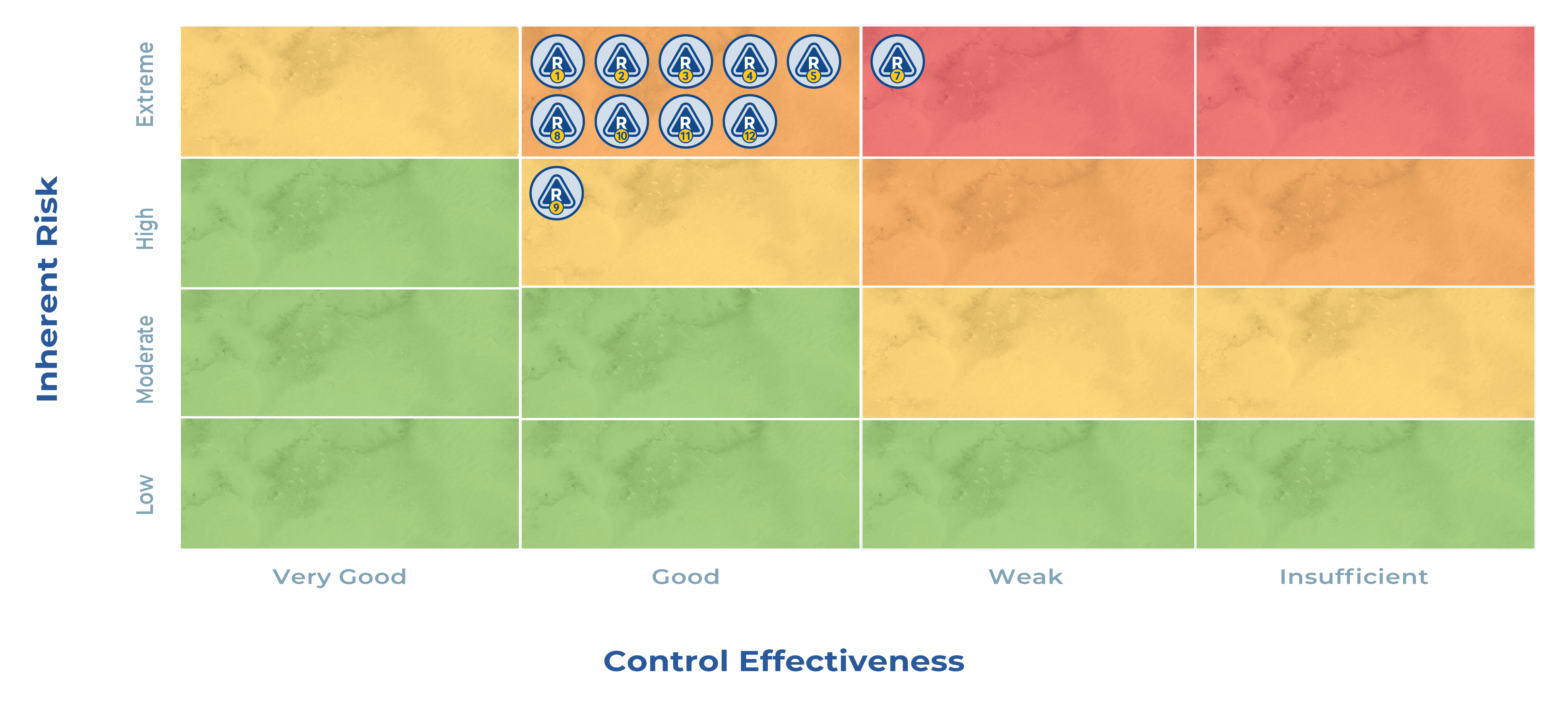
These emerging risks have been evaluated and integrated into our overall risk management approach, ensuring that SAICA remains resilient and adaptable in the face of new challenges while maintaining a focus on value creation for stakeholders. The current 12 strategic risks are illustrated in the heatmap below.
SAICA Strategic Risk Dashboard Residual Risk
ReCAlibrate
Recalibration of a microscope eliminates blur while turning observation into revelation. Science demands both.
The calibration of the lenses of a microscope enables focus and clarity to atomic sharpness, while its optics align to illuminate a hidden world. Each calibrated adjustment reveals cellular details while each beam unlocks secrets invisible to the naked eye.